“Reservation Is the Only Thread Connecting Us With the Indian State”: Rahul Sonpimple
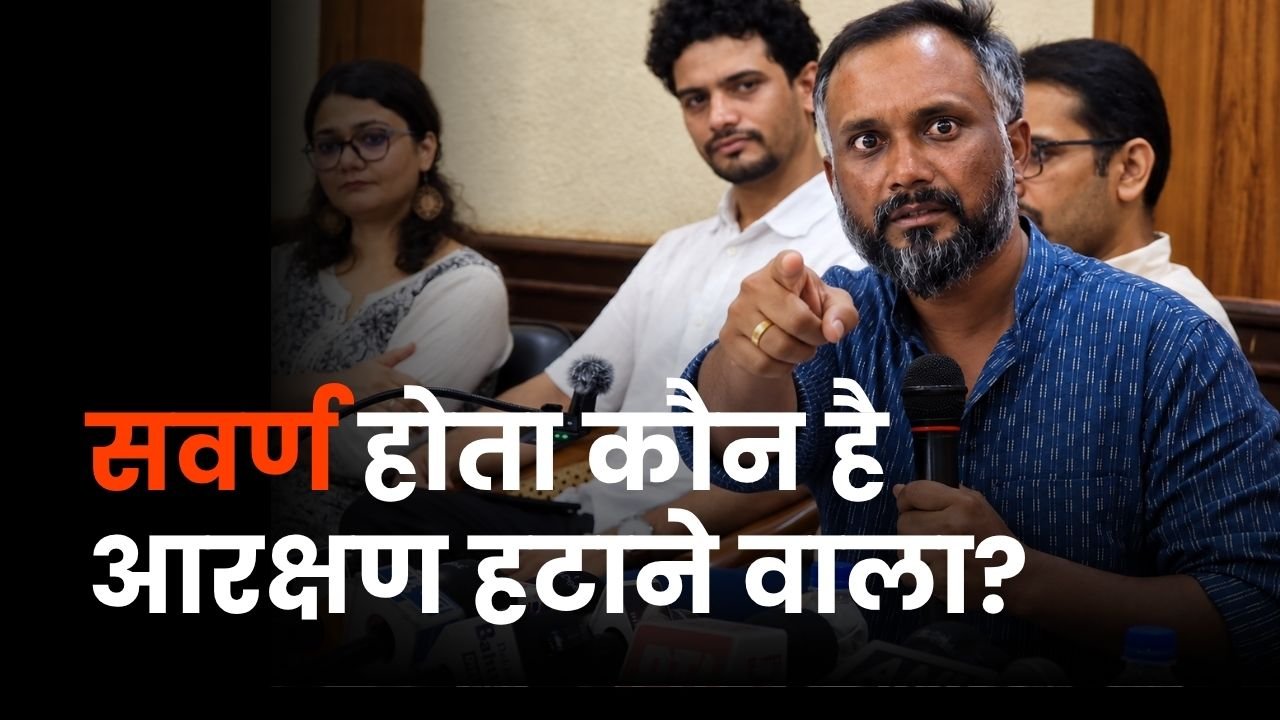
In a major address organized by the All India Independent Scheduled Castes Association (AIISCA) on September 27 at the Press Club of India in New Delhi, activist and scholar Rahul Sonpimple articulated why reservation in the private sector is not an act of state benevolence, but an unfulfilled constitutional contract. Tracing the history of affirmative action from the Round Table Conferences and the Poona Pact to post-1990 privatization, Sonpimple called on Bahujan youth to abandon defensive posture, confront caste discrimination assertively, and demand legislative accountability from both ruling and opposition parties. Below is the complete transcript of the speech translated into English.
‘Reservation Is a Contract, Not Charity’
Jai Bhim to everyone.
The All India Independent Scheduled Castes Association (AIISCA) has dedicated itself relentlessly to the demand for reservations in the private sector, even in the face of severely limited resources. This has not traditionally been a ‘popular’ demand. The dominant public narrative around Scheduled Castes has historically centered almost exclusively around atrocities—our people take to the streets only when something unspeakably heinous occurs. When it comes to proactive, structural demands, our community often hesitates or views them as distant impossibilities.
A Caste Census once seemed equally impossible. Growing up in a household where my elder brother was active in social movements, I used to wonder why older activists constantly debated these issues. As I grew up, I heard continuous discussions around the Caste Census. Ultimately, the Bahujan struggle forced even a reluctant government—which previously labeled a caste census as divisive—to concede that it must be conducted. Ideological struggles are prolonged; they do not evoke instant emotional outbursts, but persistence turns distant goals into reality.
Our team has put together a research document on our socio-economic status. I request our youth to read it closely, because understanding our condition is vital.
The Historical Roots: Reservation as a Political Contract
Reservation is not a modern policy innovation; it was a deeply political issue when the British ruled India. As colonial rule drew toward its close, the British sought a constitutional framework acceptable to competing factions to govern post-colonial modern India. Multiple groups presented their visions: the Hindu Mahasabha, the Congress under M.K. Gandhi, and the Muslim League under Muhammad Ali Jinnah.
Crucially, the Depressed Classes were organized under the leadership of Dr. B.R. Ambedkar, alongside leaders like Jogendra Nath Mandal in Bengal and M.C. Rajah in the South, converging under the Scheduled Castes Federation.
When Babasaheb represented the Untouchables at the Round Table Conference, he placed a fundamental proposition: those designated as Untouchables are not Hindus. Since Muslims already had separate electorates under British administration, Babasaheb argued that the Depressed Classes were equally entitled to separate electorates with a dual voting system.
This was an intrinsically modern demand. In South Asian and traditional Asian societies, the native episteme lacked the concept of fundamental rights. The concept of ‘rights’ and ‘human rights’ emerged from Western modernity and the Enlightenment. When the British introduced legal concepts of individual rights, it created institutional cracks through which education for women, the abolition of Sati, and the admission of Untouchables into schools became possible. In my home region of Vidarbha, whenever British officers insisted that Mahar children sit inside classrooms, local landed elites and Brahmins organized protests against the colonial administration. Ironically, our mainstream historians later mischaracterized those conservative agitations as part of the ‘anti-British freedom struggle’.
Gandhi was primarily a Hindu leader—not a Muslim leader, and certainly not the leader of the Untouchables. When Gandhi claimed at the Round Table Conference to represent everyone, including the Untouchables, Babasaheb directly countered him: “No, you are not their leader. I am their leader.” The British accepted Babasaheb’s superior reasoning.
Failing on rational arguments, Gandhi resorted to emotional coercion—a hunger strike unto death in Poona. In sociology, Émile Durkheim spoke of the ‘collective consciousness’. When an eight-year-old child and an eighty-year-old man from the dominant castes repeat the exact same uninformed slogans against reservations without knowing a single constitutional clause, that is collective consciousness at work.
Because of the physical threats to Babasaheb and our community, Dr. Ambedkar entered into a negotiated agreement—the Poona Pact of 1932. A contract (samjhauta) is an agreement between equals. In that pact, Babasaheb surrendered the hard-won right to separate electorates. In return, the incoming modern Indian State pledged reserved seats in legislatures and public employment.
Similarly, the Fifth and Sixth Schedules of the Constitution were a covenant with Adivasi communities, guaranteeing regional autonomy to govern their own lands and protect their culture. These were constitutional contracts, not acts of charity handed down by the ruling elite.
The Contradiction of Political Democracy
When Dr. Ambedkar presented the Constitution, he delivered a historic warning: we were entering a life of contradictions. In politics, we achieved equality through the principle of ‘one person, one vote; one vote, one value’. But in social and economic life, extreme inequality persisted.
The vote of Mukesh Ambani carries the exact same legal weight as the vote of a malnourished youth living in a slum. But when they return home from the polling booth—one to Antilia and the other to a temporary shanty—their lived realities remain worlds apart. Babasaheb warned that if this contradiction were not resolved, those who suffer from inequality would blow up the structure of political democracy.
Has that inequality diminished? Not at all.
Jinnah refused to trust the majority, walked away, and secured a separate state. Babasaheb chose to trust the democratic process, believing that modern governance would gradually dismantle feudal caste structures. Yet, following the electoral defeat of the Scheduled Castes Federation, Babasaheb remarked in his BBC interview that democracy would struggle to survive on such unyielding caste soil. He foresaw that without independent political bargaining power, marginalized communities would be reduced to mere petitioners.
The Fragile Umbilical Cord: Why Reservation Protects the Upper Castes
When an Adivasi in Vidarbha or Bastar confronts state aggression, they speak with absolute clarity: “You stole our land, our forests, our mineral wealth.” They do not apologize.
Why do Scheduled Castes remain perpetually on the defensive? Why must a Dalit PhD scholar feel obligated to explain the fundamentals of affirmative action to someone arguing in bad faith?
Consider this: Dalits, Adivasis, and OBCs make up the vast majority of this country. What connects our people to the entity known as the Indian State? Do our youth receive multimillion-rupee port concessions, airport monopolies, or mining leases? The sole institutional bridge connecting our communities to the Indian State is affirmative action (reservation).
To the dominant castes—who constitute less than 15% of the population and clamor for the abolition of reservations—I say this: Reservation is the reason you are safe.
Reservation is a democratic peace treaty. When a hungry person is locked out, watching a feast behind a pane of glass while their children starve, they will eventually break the glass and enter. If you dismantle the sole democratic mechanism that provides marginalized communities a stake in the system, you push society toward total anarchy. Reservations have preserved civil order in India far more than they have benefited the backward classes.
Post-1990 Privatization and the Demand for Private Sector Quotas
Since the economic reforms of the 1990s, the Indian State has drastically curtailed public sector employment. In resource-rich regions, public sector mining companies once offered unionized jobs and social security to local tribal and Dalit families. Today, those public resources have been transferred to private corporate monopolies.
Under slogans like “minimum government, maximum governance,” the State has abdicated its constitutional obligations. Private corporations clear natural habitats, extract minerals, and refuse to employ local communities, relying instead on contract laborers who are denied living wages and union rights.
If public wealth is systematically privatized, reservations must follow that wealth into the private sector.
Instead of expanding this safety net, the state apparatus tolerates hate campaigns against reservations. When a Dalit student is driven to suicide in an elite institution like the IITs, the mainstream media hosts prime-time debates rationalizing the tragedy or blaming the victim. When an institutional tragedy occurs, dominant-caste anchors and commentators protect the status quo.
The Prime Minister frequently highlights his OBC identity during elections. Yet, it was Dr. Ambedkar who insisted on the establishment of the Backward Classes Commission under the Constitution—which led to the Kaka Kalelkar Commission and paved the way for OBC representation. Why then does the administration remain silent when Bahujan students face institutional harassment in higher education?
Our youth must abandon the psychology of victimhood and defeatism
I want to say one thing very clearly to our youth. I come from Maharashtra, where the Dalit Panthers were founded, and we know the militant legacy of the Dalit Panthers.
There is one profound lesson I have learned from feminism. Feminism teaches that whenever a society enforces a rigid code of morality, the very first thing you must do is break that morality.
In this country, those of us who come from marginalized backgrounds are constantly lectured on morality. We are taught: ‘Even if someone insults you or abuses you, do not abuse them back. Maintain your dignity.’ This is not noble. In Nietzschean terms, this is pure slave morality—a psychology where you fool yourself into feeling proud by saying, ‘Look, he hurled abuse at me, but I took the moral high ground and stayed quiet.’ No. That is not how resistance works. That is not how liberation happens.
I say this clearly. If someone hurls casteist abuse at you, give it right back to them with greater force. If someone laughs at your struggle, mock them back louder. If someone tries to assault you, defend yourself and break their hand.
Do not die. Our parents did not endure generational indignity so that our generation would commit suicide in premier educational institutions. My father pulled a cycle rickshaw with his bare hands; my mother worked on construction sites. We survived extreme deprivation not to surrender our lives to prejudiced professors or hostile administrators. If an academic gatekeeper attempts to sabotage your career, find another way forward, but never surrender your life.
A Call to Action
October 2 marks the anniversary of the Poona Pact, where our separate political representation was traded for public reservations. We are launching our new movement to reclaim our economic stake.
To both the ruling coalition and the parliamentary opposition: Bahujan communities are not passive vote banks. We are politically conscious citizens. If political parties stand with our demand for private sector reservations, we will stand with them. If they ignore us, we will oppose them.
We demand that a dedicated Reservation in the Private Sector Bill be tabled and thoroughly debated in the upcoming Winter Session of Parliament.
Jai Bhim. Thank you.
AIISCA Is Demanding Reservation in the Private Sector
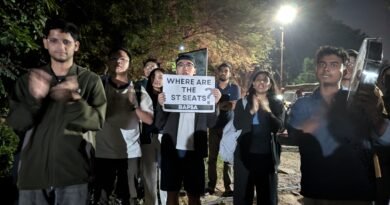
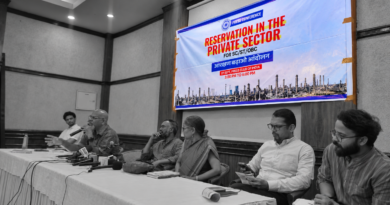
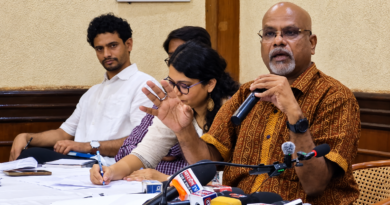
On September 27, the All India Independent Scheduled Castes Association (AIISCA) held a press conference at the Press Club of India in New Delhi demanding reservation for Scheduled Castes, Scheduled Tribes and Other Backward Classes in the private sector.
The press conference was also addressed by professors Sumeet Mhaskar, N. Sukumar and Sonajharia Minz, and student leaders Ashutosh Vidrohi, Ashwini Kumar, Bhoma Ram and Aishwarya. The organisation has been campaigning for private-sector reservation since its National Delegates Conference in October 2023, where it says it passed its first resolution on the issue.
AIISCA argues that the expansion of privatisation has shifted employment, education and economic power away from institutions where constitutional reservation currently operates. Its campaign document therefore calls for reservation in private-sector employment and education, an Equal Employment Opportunity Act, caste-disaggregated employment data, safeguards against workplace discrimination, and greater representation in corporate capital, credit, procurement and entrepreneurship.
The organisation also cites research on caste discrimination in recruitment, wages and occupational access to argue that the private sector cannot simply be assumed to be caste-neutral.