‘Reservation Is Not Charity’: AIISCA Demands Quota in Private Sector, Calls for National Campaign
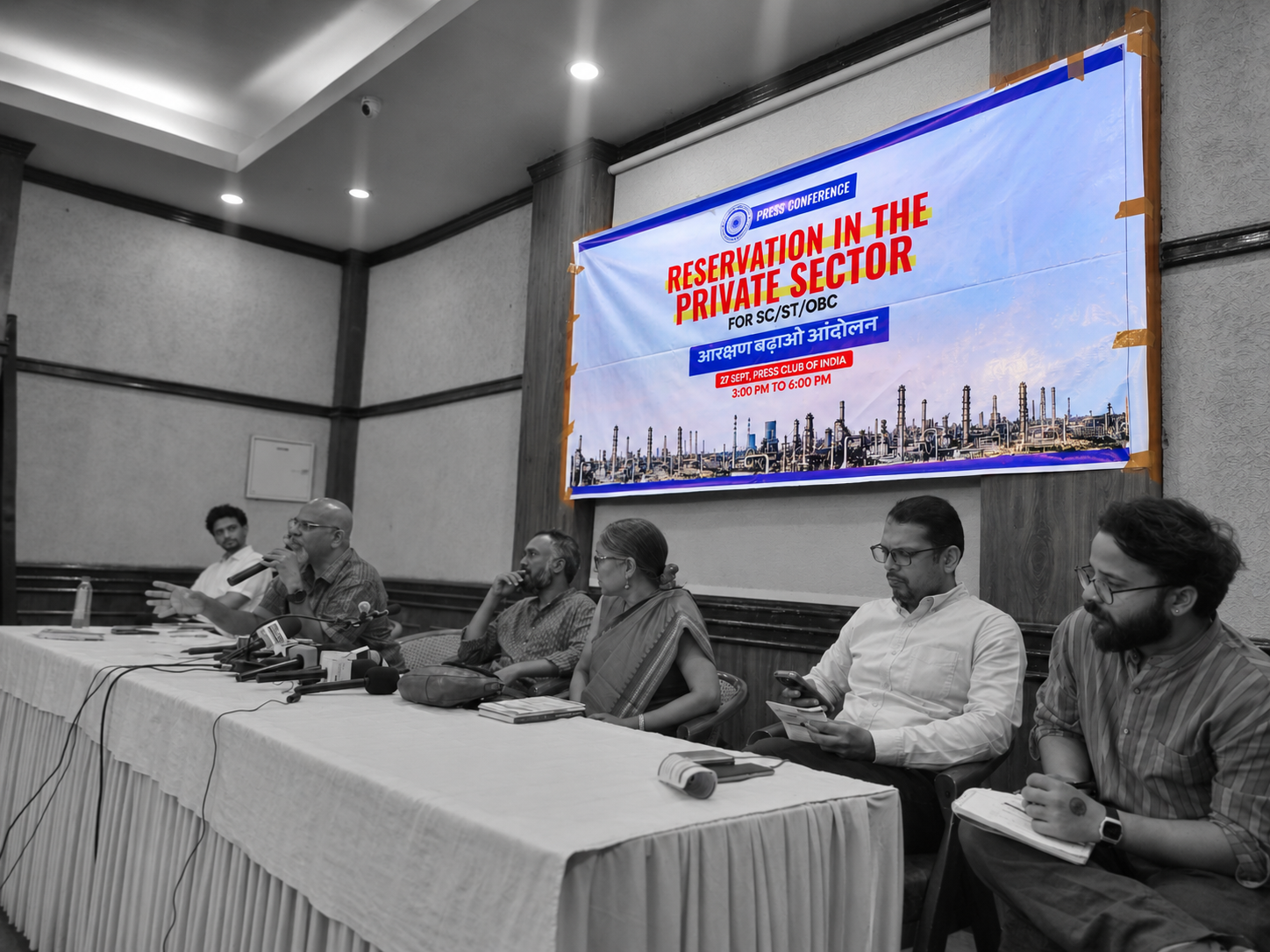
The All India Independent Scheduled Castes Association (AIISCA) on September 27 demanded reservation for Scheduled Castes, Scheduled Tribes and Other Backward Classes in the private sector, arguing that the expansion of privatisation has shifted employment, education and economic power away from institutions where constitutional reservation currently operates.
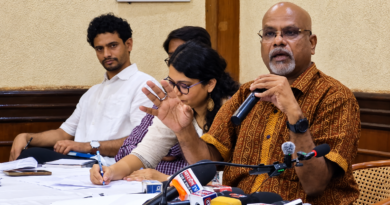
At a press conference at the Press Club of India in New Delhi, AIISCA national president Dr. Rahul Sonpimple, professors Sumeet Mhaskar, N. Sukumar and Sonajharia Minz, and student leaders Ashutosh Vidrohi, Ashwini Kumar, Bhoma Ram and Aishwarya addressed the demand.
AIISCA has pursued private-sector reservation since its National Delegates Conference in October 2023, where the organisation says it passed its first resolution on the issue.
The organisation’s campaign document, released alongside the mobilisation, argues that caste affects not only social status but access to employment, education, markets, institutions and capital. It cites research on caste discrimination in recruitment, wages and occupational access and calls for reservation, an Equal Employment Opportunity Act and caste-disaggregated employment data.
‘Reservation Is the Only Thread Connecting Us With the Indian State’
Opening his address, Sonpimple said the demand for private-sector reservation had remained difficult to popularise because Dalit political mobilisation is often associated primarily with responding to atrocities rather than making demands around representation and economic power.
“We are very quick to come onto the streets when a horrific atrocity happens to us. But when it comes to our demands, we are not seen on the streets,” Sonpimple said.
He argued that demands that initially appear distant can become mainstream through sustained political mobilisation, citing the caste census as an example. “Caste census once seemed like a distant demand. But that distant demand eventually became common sense,” he said.
According to Sonpimple, private-sector reservation should be understood as a political question rather than merely an administrative policy.
“Reservation in the private sector is, in itself, a political issue,” he said, arguing that the constitutional settlement around representation was the result of negotiations involving historically excluded communities.
He repeatedly rejected the framing of reservation as charity. “Reservation is not charity. You don’t have to defend reservation,” Sonpimple said.
He described reservation as “the only thread” connecting Bahujan communities with the Indian state and argued that this connection has become more fragile as government employment has declined and economic activity has shifted towards private companies.
‘The Private Sector Is Not Caste-Blind’
AIISCA’s campaign document argues that the private sector cannot automatically be treated as caste-neutral and cites research examining discrimination at different stages of employment.
It cites the Thorat and Attewell correspondence study, a 2011 study by Zahra Siddique, research using Indian Human Development Survey data, and subsequent research on caste-based earning differences. The document says these studies identify discrimination in recruitment, callbacks, occupational access, wages and private-sector employment.
The organisation’s document also argues that private education has become increasingly important. It cites AISHE 2021–22 figures showing that 65.3% of responding colleges were private unaided institutions and that India had 473 private unaided universities in that survey.
Bhoma Ram: ‘Access to Education Is the First Stage’
Bhoma Ram, a JNU School of International Studies student leader and AIISCA activist, connected the demand to his own experience of entering higher education from Barmer, Rajasthan.
“Reservation is a basic necessity. It is the first stage for entering or getting access,” Ram said. He described a campaign through which students from marginalised communities were assisted in applying for CUET-UG and PG examinations.
According to Ram, around 1,900 students applied through the initiative, around 1,100 qualified, but only about 500 ultimately entered central universities. “You can imagine the gap between 1,900 people appearing for the examination and only around 500 getting into central universities,” he said.
Ram argued that access to public education itself remains unequal and that privatisation makes the question of representation in private institutions more significant. He also rejected the argument that reservation necessarily compromises efficiency. “It’s not that quality decreases because of reservation. There is no such evidence,” Ram said, referring to research he said had examined the performance of SC and ST officers in the public sector.
He argued that reservation should not be understood as selecting unqualified candidates. “We are not saying that those who are not qualified should be taken. At least take those who cross the criteria that you have set,” he said.
Ram also raised the issue of caste disclosure in private workplaces, saying workers from marginalised communities can fear revealing their caste because of possible discrimination in recruitment and employment.
Ashutosh Vidrohi Calls for Nationwide Mobilisation
Ashutosh Vidrohi, president of the Ambedkar Students’ Association and an AIISCA activist, said the Delhi press conference was intended to begin a larger campaign.
“This is not the only meeting or the only press conference,” Vidrohi said. “We genuinely want to take forward the campaign for reservation in the private sector.”
He described the shrinking public sector and expansion of privatisation as a central challenge to the existing reservation framework. Vidrohi said the issue should be understood as part of the unfinished struggle for social justice.
“If this country’s government genuinely wants social justice and the liberation of Bahujans, then it is essential to join this issue,” he said. He appealed to organisations and political parties to make private-sector reservation part of their social-justice agenda.
AIISCA Seeks Equal Employment Opportunity Law
Beyond quotas, AIISCA is demanding a comprehensive Equal Employment Opportunity Act covering recruitment, wages, promotion, workplace treatment, termination, occupational allocation, contract employment and professional advancement.
The organisation is also demanding mandatory caste-disaggregated data on recruitment, promotions, salaries, senior management, contract employment, workplace discrimination, ownership and entrepreneurship.
AIISCA’s proposed framework combines reservation, equal employment opportunity, transparency, representation and economic empowerment rather than treating reservation as the sole mechanism.
Its demands also extend to private educational institutions, business ownership, corporate capital, credit, procurement and entrepreneurship.
Demand Comes Amid Renewed Anti-Reservation Mobilisation
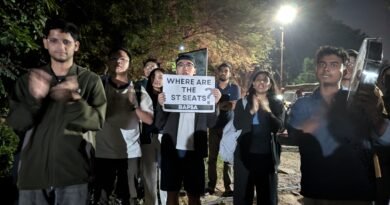
The press conference comes amid renewed mobilisation against caste-based reservation in Delhi.
The Reservation Hatao Andolan, later referred to in some reporting as the Reservation Reforms Andolan, organised demonstrations at Jantar Mantar in August, with participants calling for changes to caste-based reservation and advocating economic criteria. The mobilisation also drew a meeting between its representatives and Union Minister J.P. Nadda.
Separately, the Delhi High Court, in a September 24 order concerning a case arising from an online programme titled “Reservation Hatao Andolan Nautanki & More,” recorded allegations of caste-based abuse directed at Azad Samaj Party leader Chandrashekhar Azad. The court, after examining the video and transcript, said it was prima facie of the view that caste names and slurs had been used with a view to humiliate him under Sections 3(1)(r) and 3(1)(s) of the SC/ST Act. This finding concerns the specific video and accused before the court and does not establish that every participant in the broader anti-reservation mobilisation engaged in such conduct.
Against this backdrop, AIISCA is seeking to move the debate in the opposite direction—from protecting existing reservation in government institutions to extending affirmative action into private employment and economic institutions.
‘Reservation Must Expand From the State to the Economy’
AIISCA’s campaign document argues that political equality cannot be sustained alongside deep social and economic inequality if large sections of citizens remain excluded from quality education, secure employment, capital and institutional power.
Its eight-point demands include reservation in private-sector employment, affirmative action in private education, an Equal Employment Opportunity Act, caste-disaggregated employment data, safeguards against workplace discrimination, affirmative action in corporate capital and entrepreneurship, and equitable access to credit and procurement.
Sonpimple said AIISCA wants the issue debated in Parliament during the coming Winter Session and urged both the ruling party and opposition to take a position on private-sector reservation. “We are not simply voters. We are conscious people,” he said. “If you are with our demands, we are with you. If you are not with our demands, we are against you.”
AIISCA has announced a public meeting on October 2 at Dr B.R. Ambedkar Bhawan, Rani Jhansi Road, Jhandewalan, Delhi, from 3 pm to 6 pm, as part of its campaign for reservation in the private sector.