
Beyond the ₹1.65 Lakh Crore Figure: Beena Pallical Decodes Why Only 3.2% Reaches Dalits Directly
While headline figures in the Union Budget boast massive allocations under the Development Action Plan for Scheduled Castes and Scheduled Tribes (DAPSC & DAPST), an empirical breakdown reveals a stark reality: nearly 70% of these allocations are diverted at inception into general infrastructure and corporate subsidies.
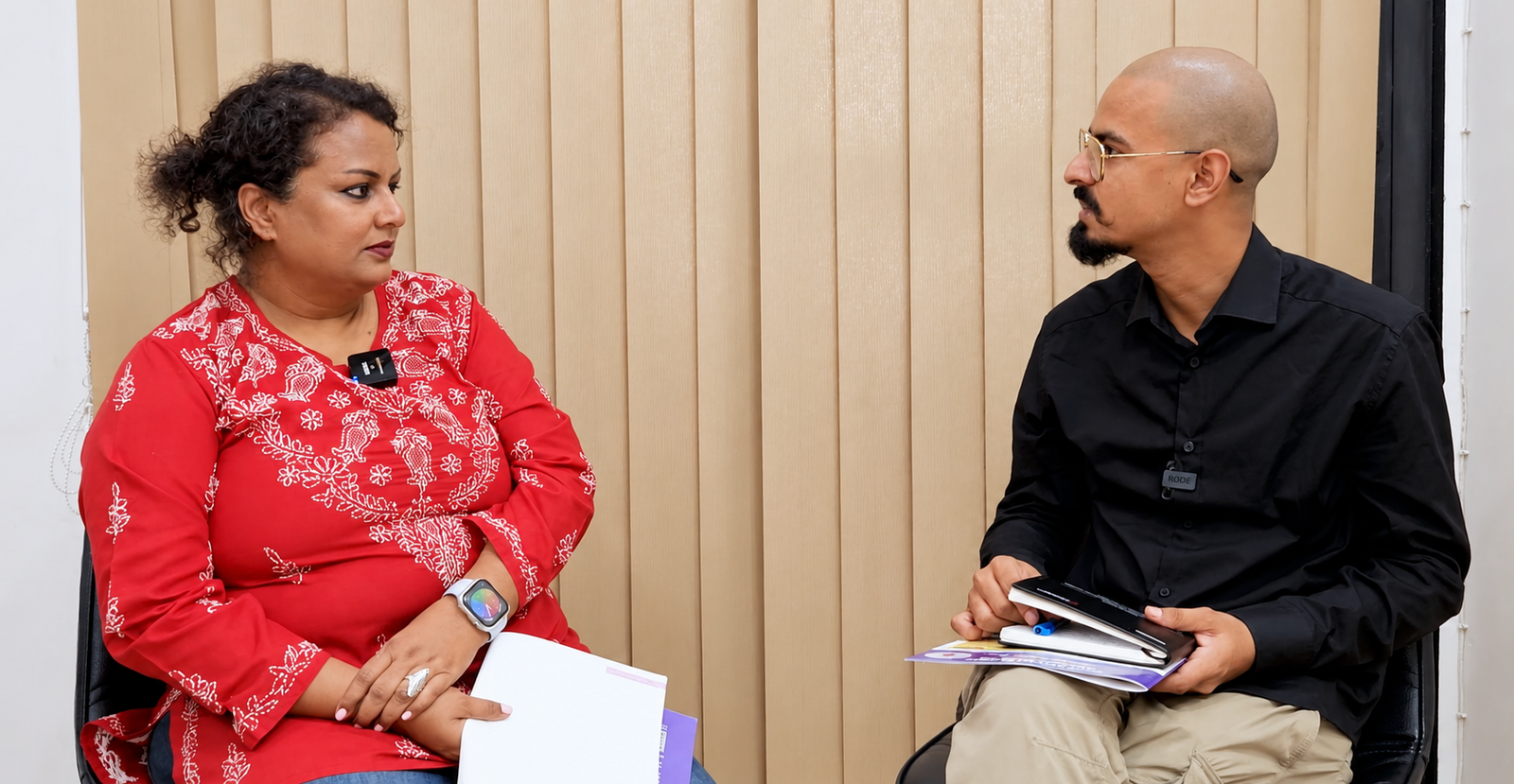
In this in-depth conversation with Manish Sagar of Bahujan Lives Matter, Beena Pallical—General Secretary of the National Campaign on Dalit Human Rights (NCDHR) and Dalit Arthik Adhikar Andolan (DAAA)—unpacks how urea subsidies, national highways, and flyovers are masked as Dalit welfare, while life-saving scholarships and atrocity relief funds face chronic neglect.
Below is the translated transcript of the interview.
Full English Translation of the Interview
Manish Sagar: Welcome everyone. In today’s podcast on Bahujan Lives Matter, we are joined by Beena Pallical. Beena serves as the General Secretary of the National Campaign on Dalit Human Rights (NCDHR) and the Dalit Arthik Adhikar Andolan (DAAA). She is also the first Dalit woman to address the United Nations General Assembly in 2011, and she represented the community there again this year.
Today, we will dissect the Union Budget 2024–25: what has actually been allocated for Dalits, Adivasis, and marginalized women, what critical funding is missing, and how resources are systematically diverted. Welcome to Bahujan Lives Matter, ma’am.
Beena Pallical: Thank you, Manish.
Manish Sagar: Ma’am, after the interim budget earlier this year, the full Union Budget of NDA 3.0 was tabled. When we look at the final allocations for Dalits and Adivasis, how do the numbers compare to the interim estimates, and what is the reality behind the headline figures?
Beena Pallical: If you compare the interim budget to the final full budget, there is barely any structural difference. The figures are largely identical. There are no transformative new schemes or vision for the community. The gross allocation has increased marginally only because the aggregate size of the national budget expanded.
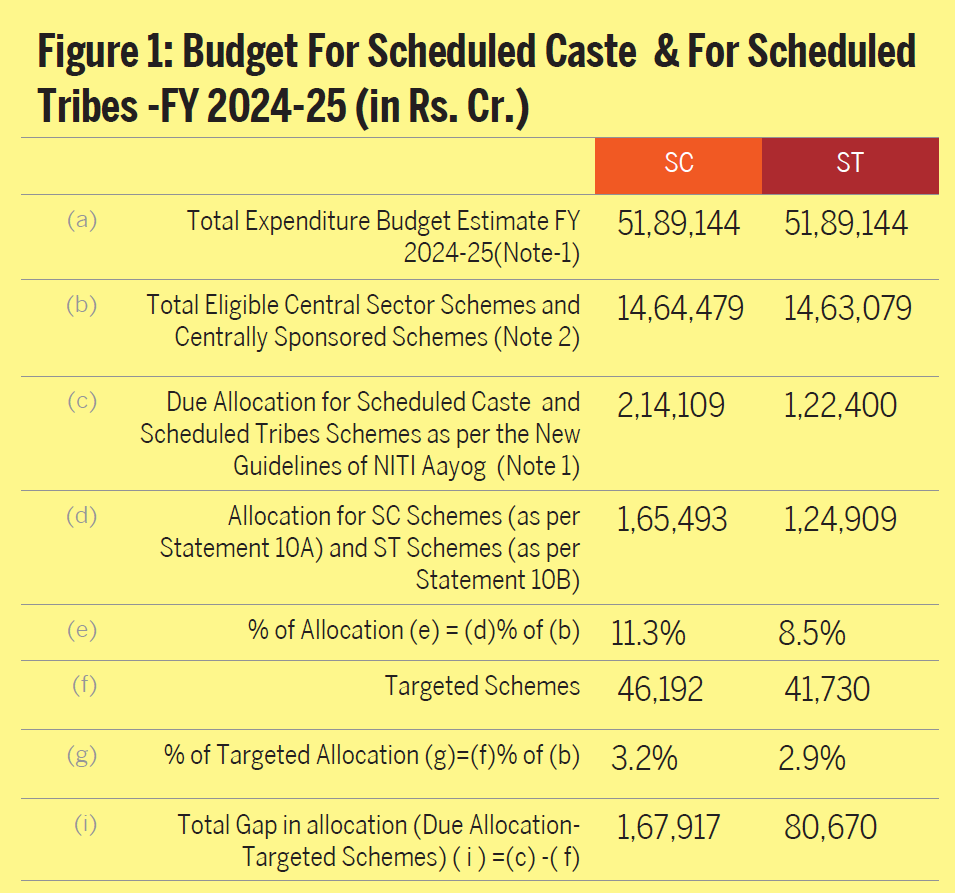
However, if you evaluate allocations against population proportions, the shortfall is obvious. According to historical Jadhav Committee norms and the census, Scheduled Castes should receive a minimum 16.6% allocation from eligible scheme funds. Instead, SC schemes received only 11.3%. Scheduled Tribes received 8.5%.
Herein lies the primary deception: of the total ₹1,65,493 crore marked on paper for Scheduled Castes, only 3.2% (₹46,192 crore) actually reaches Dalit communities through direct, targeted schemes. For Scheduled Tribes, out of ₹1,24,909 crore, only 2.9% (₹41,730 crore) reaches them directly.
The rest of the money—nearly 70%—is parked in general, non-targeted schemes.
Manish Sagar: When you say “general schemes,” what does that mean in policy terms?
Beena Pallical: As per the policy guidelines of the Special Component Plan (SCP/DAPSC), funds must satisfy specific conditions: they must be population-proportionate, directly impact Dalit and Adivasi households or settlements, or provide individual entitlements like scholarships.
Instead, the government allocates funds from the SC/ST budget into massive universal infrastructure projects—like constructing national highways or broad universal water pipelines under the Jal Jeevan Mission, which absorbs over ₹15,000 crore from the SC budget alone. Unless you explicitly delineate how many Dalit colonies or households are receiving functional tap connections, it remains a general scheme. Everyone uses highways, but funding them from the Dalit development budget is an accounting manipulation.
Take an even more egregious example: Urea and fertilizer subsidies. Over ₹10,500 crore from the SC budget is allocated to domestic and imported urea subsidies. Over ₹3,800 crore goes to nutrient-based fertilizer subsidies.
Now ask yourself: what is the primary prerequisite for using chemical fertilizer? Land ownership. The overwhelming majority of Dalits in this country are landless agricultural laborers. If our people do not own land, whose farms is this subsidized urea fertilizing? It directly subsidizes dominant-caste landed farmers, yet the expenditure is booked under Dalit welfare!
Manish Sagar: That is staggering. The landless community’s budget is used to subsidize fertilizers for large landowners. Meanwhile, critical educational schemes are starved of resources. What is happening with the Post-Matric Scholarship (PMS) and the National Overseas Scholarship (NOS)?
Beena Pallical: This is where the damage is most acute. For the Post-Matric Scholarship, our long-standing civil society demand has been an allocation of at least ₹10,000 crore to match surging enrollment and inflation. In this budget, the Post-Matric Scholarship for Scheduled Castes received ₹6,349.97 crore—which is actually a reduction compared to last year’s allocation of ₹6,359.14 crore! For ST students, it stands at ₹2,374.15 crore.
As for the National Overseas Scholarship (NOS)—which enables Dalit and Adivasi scholars to pursue Masters and PhD degrees abroad—the allocation is negligible. For Scheduled Tribes, the entire national budget for overseas scholarship is a meager ₹6 crore! For Scheduled Castes, it is ₹95 crore. With tuition, airfare, and living stipends in international universities, how many students can ₹6 crore support nationally? A mere handful.
Manish Sagar: And on top of meager funds, they have introduced bureaucratic conditionalities. We saw reports where states like Karnataka diluted scholarship avenues, and student activists like Sumit Samos have highlighted how arbitrary caps exclude applicants from states like Maharashtra, where Dalit assertion and applications are highest.
Beena Pallical: Absolutely. Look at the political class: the children of MPs, ministers, and affluent bureaucrats study abroad without financial hurdles because they possess ancestral wealth, corporate connections, and land.
For a Dalit or Adivasi youth, there are no ancestral orchards or estates to mortgage. State scholarships are the only gateway to higher education and world-class universities.
Manish Sagar: Even within India, higher education has become unaffordable. When I pursued my diploma at IIMC, the tuition alone was ₹2 lakh for 10 months, not counting rent and living costs in Delhi. For a student from a rural Dalit background, survival is impossible without financial support.
Beena Pallical: Exactly. And even when scholarships are awarded on paper, systemic disbursement delays force students into a debt trap. We know students who did not receive their disbursed scholarship for two to three years.
To avoid being expelled or dropping out, they are forced to borrow from local private moneylenders at extortionate interest rates. We have documented cases where doctoral scholars, during semester breaks, are forced to work as casual manual laborers on other people’s farmlands just to pay off interest on debt. Instead of enabling mobility, state negligence pulls them right back into the vicious cycle of intergenerational poverty.
Manish Sagar: We have seen explicit instances of fund diversion recently. In Karnataka, funds were redirected; in Madhya Pradesh, funds earmarked for Scheduled Castes were reportedly diverted toward cow shelters (gaushalas) and religious sites. How is the state allowed to legally divert Dalit welfare money like this?
Beena Pallical: Historically, tracking this diversion was exceedingly difficult. But in 2010, ahead of the Delhi Commonwealth Games, NCDHR tracked and uncovered that ₹744 crore was directly siphoned off from the Delhi Government’s Scheduled Caste Special Component Plan to construct sports stadiums and municipal infrastructure. Initially, the government denied it, but after sustained public campaigns and assembly floor debates, they were forced to concede that funds had been diverted.
Over the decades, we have tracked SC/ST funds being used to purchase police weapons, construct municipal swimming pools, purchase luxury government vehicles, distribute Diwali sweets, and build cow shelters.
Under established planning principles, this is an administrative crime. But who questions it? The prevailing political mentality assumes: “Who is going to audit Dalit funds? Don’t Dalits use roads? Don’t Dalits walk past stadiums?”
At the end of the day, it reflects the deep-seated reality that Dalit and Adivasi lives simply do not matter to the policy establishment.
Manish Sagar: Let us look at the intersection of caste and gender. Dalit and Adivasi women endure extreme violence and systematic economic exclusion. What does the Gender Budget Statement reveal about them?
Beena Pallical: The picture for Dalit and Adivasi women is appalling. According to NCRB data, atrocities against Dalit women and girls constitute over 15% of all crimes registered under the PoA Act, with reported atrocities rising by 46% over recent six-year spans. Every single day, women from our communities face sexual violence, custodial assault, and systemic humiliation.
Our demand has consistently been that at least 50% of the Dalit and Adivasi budget must be specifically dedicated to women—for secondary education, hostels, nutrition, land rights, and judicial protection.
Yet, when you look at the Gender Budget Statement for 2024–25. From the total eligible Central Sector and Centrally Sponsored schemes, Dalit women receive a meager 1.10%. Adivasi women receive just 0.59%!
Look at access to justice: for the implementation of the Protection of Civil Rights (PCR) Act and the SC/ST (Prevention of Atrocities) Act across the entire country, the government allocated barely ₹550 crore. For targeted access to justice for SC/ST women survivors, the allocation is confined to an insignificant ₹165 crore.
With trial pendency rates in Special Courts hovering above 93% and conviction rates languishing around 34%, how do you establish exclusive fast-track courts, provide witness protection, or deliver mandatory victim compensation with such negligible funds?
Manish Sagar: When you look at the entire landscape—education, sanitation, manual scavenging, and atrocities—the rhetoric of Viksit Bharat stands in sharp contradiction to the budgetary reality of Dalits and Adivasis.
Beena Pallical: Precisely. Real empowerment requires binding, statutory legislation. Until the Central Government enacts a national SC/ST Development Action Plan Act (Statutory SCP/TSP Legislation) that makes diversion a punishable criminal offense, the bureaucracy will continue to balance fiscal deficits on the backs of Dalit and Adivasi communities.
Manish Sagar: Thank you so much, Beena, for speaking with Bahujan Lives Matter and breaking down this critical budget analysis.
