Privatization and Contractualization of Public Sector Is Killing Reservation — N. Sukumar
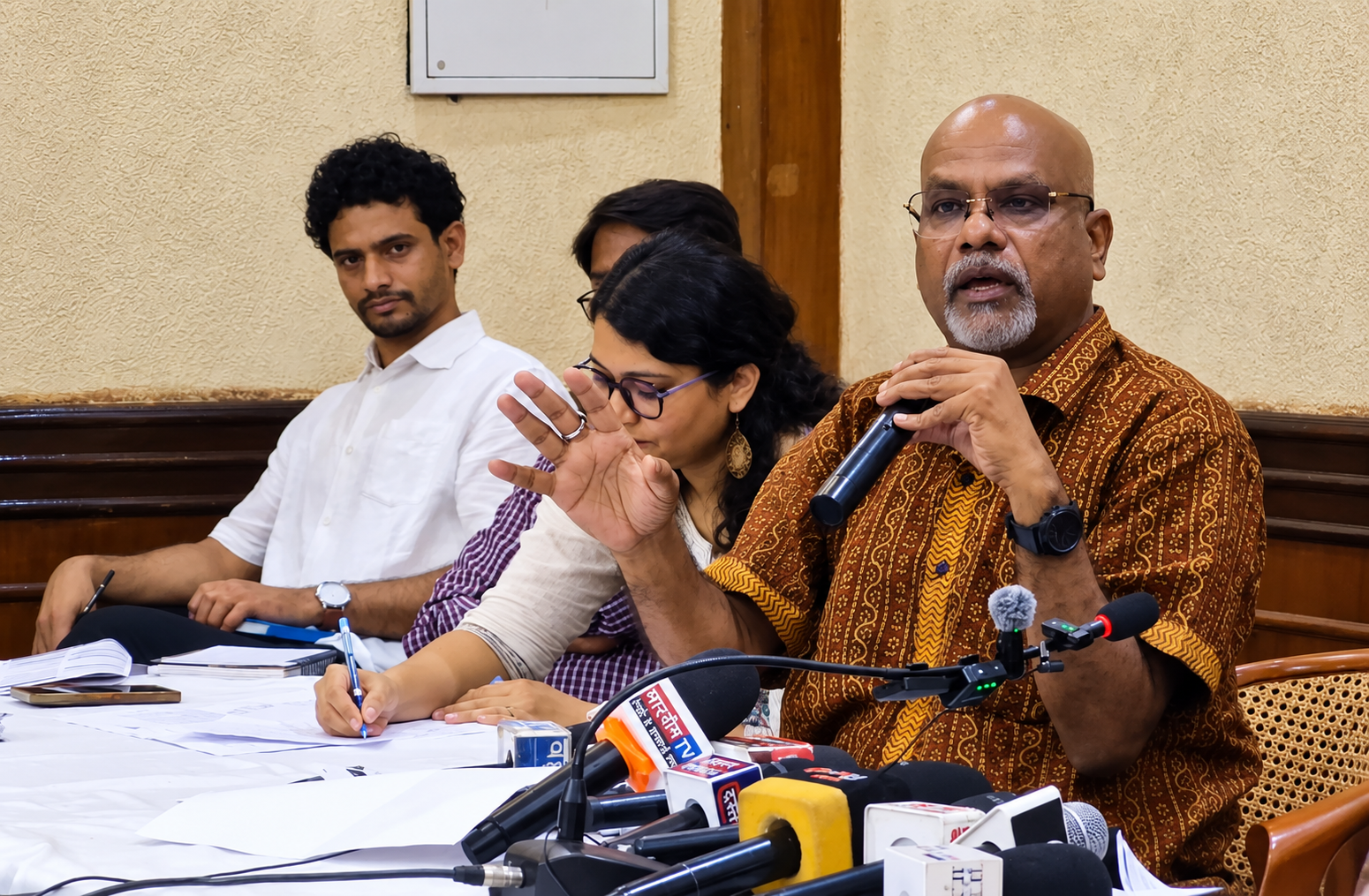
Speaking at an event organized by the All India Independent Scheduled Castes Association (AIISCA) on September 27 at the Press Club of India in New Delhi, Prof. N. Sukumar of the Department of Political Science, Delhi University, delivered a sharp critique of the systemic dismantling of public sector employment in India. Presenting empirical data on declining government vacancies, strategic disinvestment, and the widespread contractualization of university and administrative staff, Prof. Sukumar argued that the push toward privatization functions as a deliberate backdoor method to dismantle affirmative action. Below is the translated, structured transcript of his address.
‘Privatization and Contractualization Are Conspiracies to Kill Reservation’
Jai Bhim to everyone.
Today, we are gathered here to defend the very idea of reservation. Reservation is not charity. Even when we demand affirmative action in the private sector, it is a matter of constitutional right.
Private entities cannot simply declare: “We are private, we will operate however we like, and we will refuse to implement reservations.” You operate under a constitutional framework that enshrines social justice; you must respect that. Nothing is purely private—everything is political.
The demand for affirmative action in the private sector is not novel; it has been actively raised since 2004. It is high time this demand becomes a nationwide mobilization. I want to express my gratitude to Rahul Sonpimple and the young activists of the All India Independent Scheduled Castes Association (AIISCA) for taking the initiative to organize our community at a moment when state-sponsored campaigns against reservation are so openly visible. Ambedkarites will not quietly accept this hostility.
The Bipartisan Consensus and Corporate Evasion
Ever since the introduction of Liberalization, Privatization, and Globalization (LPG) policies, the public sector and public employment avenues have faced sustained contraction. During the first NDA government, a dedicated Ministry of Disinvestment was instituted. The political strategy became clear: if you cannot abolish reservation constitutionally, dismantle the public sector entirely. Once public sector enterprises are liquidated, the obligation to implement affirmative action disappears automatically.
Let us look at modern political history. In 2003, former Prime Minister Atal Bihari Vajpayee met with Scheduled Caste and Scheduled Tribe Members of Parliament and expressed institutional support for affirmative action in the private sector. Private corporations must understand that their enterprises are built on public resources: subsidized land, water, electricity, state incentives, and public infrastructure. You are accountable to the constitutional mandate; you are not above the government. Subsequently, under the UPA government, Dr. Manmohan Singh, along with political formations across the Left, Right, and Center, acknowledged this necessity.
In 2024, Member of Parliament Chandrashekhar Azad introduced a Private Member’s Bill mandating that the government incentivize private enterprises to implement quotas and establish enforceable guidelines for affirmative action.
Between 2004 and 2024, corporate lobbies—including the Confederation of Indian Industry (CII), the Federation of Indian Chambers of Commerce & Industry (FICCI), and ASSOCHAM—claimed they would explore “voluntary affirmative action”. Voluntary action in a caste society is hollow. If a measure is entirely optional, dominant corporate gatekeepers simply ignore it. Even the Parliamentary Committee on the Welfare of Scheduled Castes and Scheduled Tribes has affirmed that reservation in private education and employment is an absolute necessity.
The Empirical Shrinking of Public Employment
The systemic phasing-out of public enterprises reflects an anti-reservation mindset. Let us look at official government statistics:
Dwindling Central Government Employment: In 2001, central government employees across diverse cadres stood at approximately 34.2 lakh against 36.06 lakh sanctioned posts. By 2023, actual employment had dropped to 30.04 lakh despite sanctioned posts increasing to 39.6 lakh. The number of unfilled public vacancies climbed to nearly 9.5 lakh.
Disinvestment Across Strategic Sectors: Telecommunications, railways, air transport, and higher education are being systematically liquidated or privatized into elite monopolies.
PSU Headcount Reductions: A written reply by the Ministry of Social Justice revealed that between 2019–20 and 2023–24, regular employment across Central Public Sector Enterprises (CPSEs) dropped from 9.2 lakh to 8.12 lakh—a net loss of over 100,000 secure jobs within five years through hiring freezes and Voluntary Retirement Schemes (VRS).
National Security & Research: Even strategic organizations like ISRO and DRDO have pushed employees into early exits while transitioning core functions away from regular civil service cadres.
The Case of Coal India: Coal India’s workforce historically stood at roughly 7 lakh workers; it has been reduced to approximately 2.4 lakh—a massive contraction exceeding 65%. When a public firm like Air India or BALCO is privatized, thousands of secure posts vanish from official public sector databases overnight.
Where are constitutional reservations supposed to be implemented when public employment is deliberately dismantled? While the nation celebrates Azadi Ka Amrit Mahotsav marking 75 years of independence, what substantive employment equity exists to celebrate?
Contractualization: The Modern Weapon Against Quotas
Contractualization is a calculated conspiracy to extinguish reservations. Historically, Class C and Class D positions provided marginalized communities with formal, pensionable livelihoods and a stepping stone into the urban middle class.
Today, if you walk into central universities or government offices, positions from security guards to clerical staff are hired through third-party private staffing agencies. Workers are engaged on temporary one-year agreements without job security, social security, health coverage, or quota rosters. How can public institutions expect dedicated institutional memory and high service quality when the workforce is kept permanently precarious?
The contemporary private sector accounts for over 90% of employment in India. Why should the Bahujan majority not have a rightful share in those jobs?
Agrarian Exploitation and Elite Capital
I come from a rural village in Tirupati district. In my village, there are roughly 40 households belonging to the dominant landed caste, the Kammas. Almost every one of those affluent households sent a son or daughter to the United States as a software engineer.
Where did the foundational capital to fund their overseas education come from? Did land magically cultivate itself? It was built on the physical toil, backbreaking labor, and sweat of our Dalit agricultural workers. The surplus value extracted from our labor financed their mobility and modern corporate capital. We have an absolute moral and economic claim to demand our share.
For centuries, elite social networks monopolized professions into caste cartels, excluding everyone else. Now, when we access constitutional spaces, those spaces are liquidated. Today, barely 4.5% of the total national workforce benefits from affirmative action via public sector reservations, leaving Scheduled Castes, Scheduled Tribes, and Other Backward Classes deeply underrepresented.
Debunking the Myth of “Merit” and Institutional Murder
Prime-time television debates routinely deploy the myth of “merit” to delegitimize affirmative action. Having taught in the Department of Political Science at Delhi University for over 25 years, I can say with certainty: our SC, ST, and OBC students are second to none.
The concept of “merit” is an ideological construct designed to damage the self-worth of marginalized students and gatekeep elite institutions. By systematically humiliating Bahujan students in classrooms, academic gatekeepers attempt to break their confidence.
Look at what has transpired across prestigious campuses like IIT Bombay and IIT Delhi. Over the past two decades, more than 170 student suicides have occurred across premier institutions—an epidemic of institutional neglect and casteist hostility.
Furthermore, even supposedly progressive private universities have negligible representation; institutions like Azim Premji University have barely two or three Scheduled Caste faculty members across entire campuses.
Groundbreaking empirical studies by Prof. Sukhadeo Thorat and Paul Attewell demonstrated that private corporate recruiters scrutinize resumes based on cultural capital—surnames, dietary habits, family background, and social pedigree—rather than objective skills. Our organic intellectual capability and lived resilience are far more enduring than their inherited cultural privilege.
The Road Forward: Nationalization or Radical Inclusivity
Our demands cannot be confined only to standard employment quotas. We demand our rightful share in land, industrial assets, and media capital.
Dr. B.R. Ambedkar long ago argued in States and Minorities that basic and key industries, along with agricultural land, must be nationalized under state control. If the private sector refuses to respect social justice and institutional diversity, the only democratic recourse will be the nationalization of key private monopolies.
This movement must expand onto a national platform. We must continue to compile rigorous empirical data across scholarships, recruitment rosters, and budgetary allocations to expose institutional double standards.
Jai Bhim. Thank you very much.