
‘We Cannot Operate Under Upper-Caste Crutches’: Sushila Takbhore Critiques Savarna Feminism
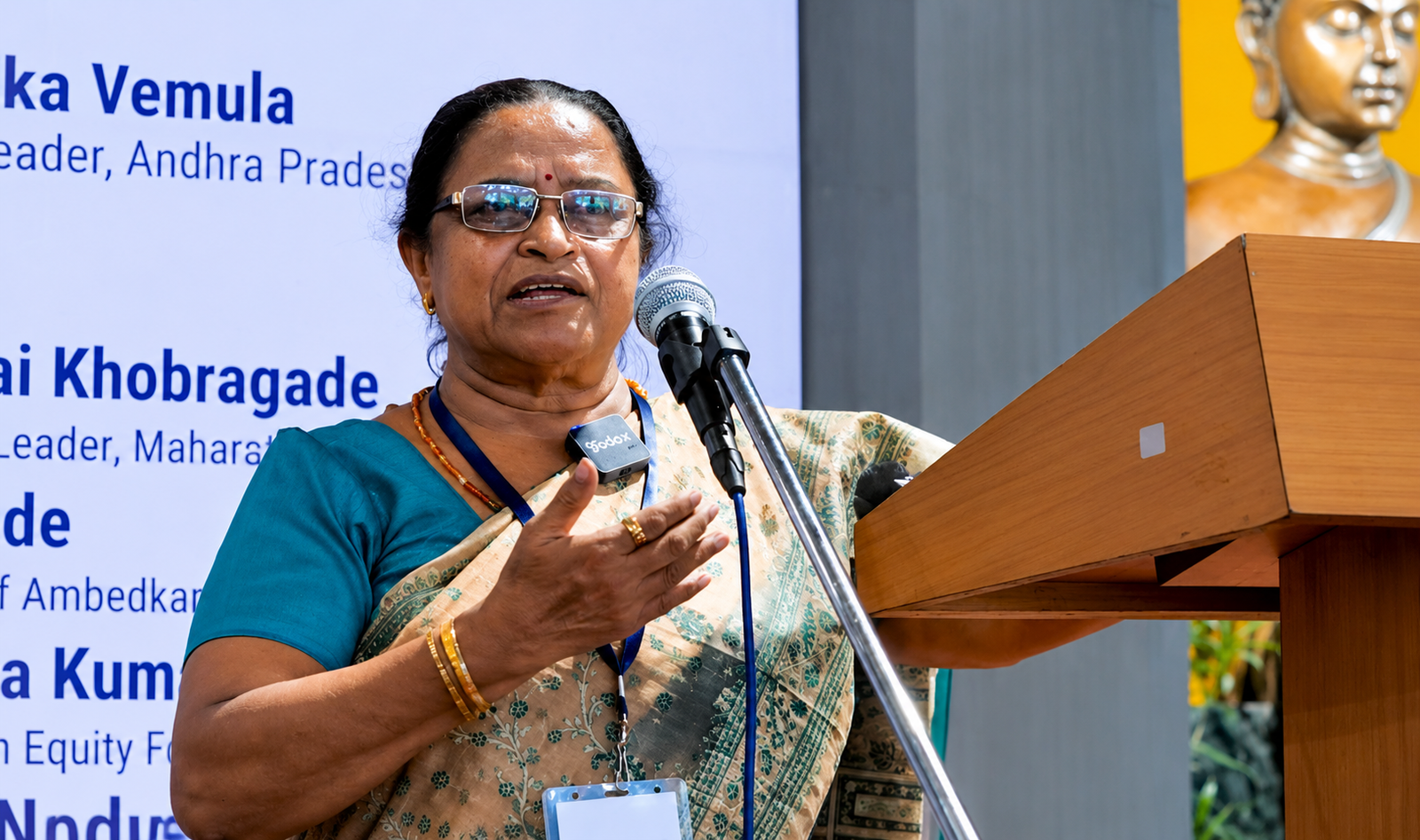
Delivering an address on the need for an independent Dalit women’s movement on 8th October 2023 in a foundational event organized by the All India Independent Scheduled Castes Association (AIISCA) a Nagpur Maharashtra, renowned author and activist Sushila Takbhore examines the dual oppression of caste and patriarchy. Drawing from her personal life journey from rural Madhya Pradesh to Maharashtra’s Ambedkarite movement, Takbhore critiques mainstream savarna feminist organizations for gatekeeping leadership, reflects on the historical contributions of Babasaheb Ambedkar and Savitribai Phule, and argues why Dalit women must lead their own struggles rather than rely on proxies.
Below is the complete transcript translated into English.
‘The Need for an Independent Dalit Women’s Movement’
Revolutionary greetings and Jai Bhim to everyone present here—to all conscious Ambedkarite youth and revolutionaries.
Looking around this room, regardless of whether someone is over forty or younger, the vibrant energy, ideological clarity, and enthusiasm make me feel that everyone here is young and dedicated to the mission.
My primary public identity has been as a literary writer. But sitting in an enclosed room writing creative literature and stepping into the field to work directly with society are two distinct realities. My writing has never been confined to a closed room; I have actively engaged with social equality movements, the Ambedkarite movement for social transformation, and the women’s liberation movement. My creative work flows directly from this ideological foundation.
Listening to Dr. Rahul Sonpimple describe his lived experiences, his family’s struggles, and the harsh realities of our settlements, one is reminded of the pain our communities continue to bear. How many among our people, struggling for basic sustenance where oil for lamps to study was once a luxury, manage to acquire higher education and guide society? It is a continuous battle. We owe an immense debt to Babasaheb Dr. B.R. Ambedkar. Were it not for the rights, safeguards, and constitutional avenues he carved out, where would we be today?
Today, Ambedkarite society has made tremendous strides. When you walk into major administrative institutions and corporate offices, you see our people’s nameplates on desks. Seeing Priyadarshini conduct this assembly with dignity is living proof that our daughters and women are guiding society from the forefront, walking shoulder-to-shoulder with men using rationality and wisdom. But the question remains: what percentage of our women are truly emancipated and organized?
From Feudal Restraint to Ambedkarite Consciousness
I was born in Madhya Pradesh in 1954. At that time, deep darkness surrounded Dalit communities in the region. Gandhi’s ‘Harijan’ movement had led our people astray—we were turned into passive observers expected to see no evil, hear no evil, and speak no evil, while reality was the complete opposite.
After completing my Bachelor of Arts, I arrived in Nagpur following my marriage. That transition marked a dramatic turning point in my life. The degrees I held were merely paper credentials until I stepped onto the soil of Maharashtra.
When I first arrived at the Nagpur railway station, descending the steps behind an extensive two-foot veil (ghoonghat) as required of brides in Madhya Pradesh and Rajasthan, my husband scolded me: “What is this spectacle?” I was taken aback. A young bride, barely setting foot in her new city, receiving a reprimand from her husband. But sometimes, a sharp rebuke points you in the right direction. It shook me into understanding that while Madhya Pradesh had one environment, Maharashtra was alive with Ambedkarite awakening.
It was 1974–75. Nagpur was vibrant with the agitations of the Samata Sainik Dal and the fiery mobilization of the Dalit Panthers. Conscious Dalit women had founded their own organizations and regularly conducted educational workshops. My husband was an activist working within the Valmiki community and broader Dalit movements. With his support, within a month of marriage, I was attending public meetings, participating in literary sessions, and reading in libraries.
Historical Roots of Subjugation and Resistance
Any conversation on women’s liberation is incomplete without invoking Krantijyoti Savitribai Phule. If we stand before microphones on public stages today, it is because of the foundational struggles of Savitribai Phule and Dr. B.R. Ambedkar.
The caste hierarchy placed Dalits outside the fourfold varna system as untouchables, forced to reside outside village peripheries. If the touch or sight of these communities was treated as polluting, imagine the systemic exploitation and humiliation inflicted upon Dalit women across centuries.
In Travancore, Kerala, Dalit women were historically forbidden from covering their upper bodies and were subjected to the humiliating ‘breast tax’ (Mulakkaram). It was a woman’s ultimate sacrifice—cutting off her own breast in protest against this feudal tax—that catalyzed the historic Channar revolt (Channar Lahala), establishing clothing rights for women.
Even today, violence against Dalit and marginalized women persists: the brutal killings of Surekha and Priyanka Bhotmange in the Khairlanji massacre, the horrifying gang-rape and hasty cremation of the young woman in Hathras without her family’s presence, and the parade of tribal women stripped of their clothing in Manipur. These incidents demonstrate that our women remain structurally vulnerable to caste and gender atrocities.
Babasaheb Ambedkar, the Hindu Code Bill, and Domestic Dignity
Before Babasaheb Ambedkar, upper-caste women lived confined behind the veil of wealthy homes, their sorrows silenced indoors, while working-class Dalit women endured exploitation in the open fields.
Who provided legal protection and social dignity to all women? It was Babasaheb Dr. B.R. Ambedkar.
Through the Hindu Code Bill, Babasaheb granted women property rights, custody rights, and the right to seek divorce from domestic abuse. He resigned from his position as India’s first Law Minister when conservative forces and Jawaharlal Nehru failed to pass the comprehensive bill in Parliament. Babasaheb was the true liberator who taught women how to live with head held high.
In July 1942, at the All India Depressed Classes Conference in Nagpur, Babasaheb addressed thousands of Dalit women, teaching them how to raise their children with dignity and self-respect. Furthermore, at the historic Mahad Satyagraha in 1927, Dalit women participated in publicly burning the Manusmriti—symbolically breaking the chains of domestic and ritual enslavement.
Confronting Internal Patriarchy Within Movements
Babasaheb famously urged our people to abandon the villages and migrate to cities, because rural villages remain strongholds of entrenched casteism. While moving to cities provided employment avenues, our women often face a double crisis: external social violence from dominant castes in society, and domestic oppression within the household.
In my novel Woh Ladki (‘That Girl’), I documented how women across seven or eight characters navigate oppression from mothers-in-law, sisters-in-law, and husbands. Too often, wives and daughters-in-law are treated as subordinate property.
I must state this truth candidly: Dalit men who passionately advocate for equality and constitutional rights on public platforms sometimes perpetrate injustice against women within their own homes.
When I wrote my autobiography Tiraskrit, people asked me: “Sushila Takbhore, how did you find the courage to expose domestic realities when your husband is still alive in the house?”
I replied: I am not just an individual woman; I am an activist of a movement. If a man who calls himself a social activist impedes his own wife from growing, that truth must be articulated publicly. Challenging domestic oppression is every woman’s duty.
The North-South Divide: Dowry, Rituals, and Superstition
Looking across India, the nature of women’s oppression varies. In North India, women suffer from acute deficits in formal literacy, autonomous organization, and economic self-reliance. In South India, despite high literacy and economic independence, the scourge of dowry has reached catastrophic proportions. Even in impoverished and Dalit households, families are pressured into providing 100 to 200 tolas of gold. Families fear having a second daughter because dowry demands bankrupt them, driving many southern women to seek employment in northern cities to escape marital blackmail.
Dowry must be resisted unconditionally. True gender equality requires that sons and daughters be treated identically from birth, putting an end to female foeticide.
Furthermore, our women must discard superstitious rituals, endless fasting, and orthodox religious ceremonies performed for the long life of husbands or the birth of male heirs. Starving oneself and submitting to superstition weakens a woman physically and mentally, leaving her incapable of critical thinking and political resistance.
Why Dalit Women Require an Independent Movement
In Delhi, during our organizing work alongside the late activist Rajni Tilak, we frequently observed upper-caste feminist organizations inviting Dalit women to their conferences.
However, the dynamic was always the same: The mic remained in their hands; the stage was occupied by them; and we were relegated to sitting quietly in the audience.
We realized then: if leadership and the banner remain in their hands, where is our self-determination? Our flag and our leadership must remain in our own hands. This is the core rationale for an Independent Dalit Women’s Movement. We cannot operate under the shadow or crutches of upper-caste feminist networks.
Nor can we allow male comrades to say: “You stay home, I will run your women’s struggle for you.” No one else can articulate our specific pain. That articulation is only possible when Dalit women step out of their homes, stand behind the microphone, and lead from the front.
Mainstream savarna feminism fails to comprehend the lived intersection of caste, labor, and patriarchy. Dalit women are the frontline opponents of religious orthodoxy and rituals, whereas dominant-caste society often clings to cultural conservatism. We must guide ourselves.
We must also break sub-caste divisions—whether Mahar, Matang, Basor, Khatik, Valmiki, or others—and build inter-caste solidarity and marriages without dowry.
Let the women’s movement be autonomous, let its leadership belong directly to Dalit women, and let the broader society stand firmly in solidarity.
Jai Bhim. Thank you.
Sushila Takbhore was born on 4th March 1954 in Banapura village in the Hoshangabad district of Madhya Pradesh. She stands as a prominent figure in Hindi Dalit literature, using her life experiences and struggles as a Dalit woman to vividly reflect them in her works. As a storyteller and poet, she has carved out a distinct identity for herself. Her early life was filled with struggles, experiencing social discrepancies from childhood. She was not allowed to eat with other children, and even rickshaw pullers returning from school would often refuse to let her sit, forcing her to walk home. Poverty, disrespect, and neglect due to her caste, along with the challenges faced as a woman, have profoundly impacted her life. Her pain and anger find vivid expression in her creations like Neela Aakash, Tumhe Badalna Hi Hoga, Vah Ladki, and Sangharsh.
