Collegium Recommends Three High Court Chief Justices for Supreme Court; All Three From Upper-Caste Backgrounds
Collegium Recommends Three High Court Chief Justices for Supreme Court; All Three From Upper-Caste Backgrounds
The Supreme Court Collegium has recommended three serving High Court Chief Justices for elevation to the Supreme Court, with all three recommended judges coming from upper-caste backgrounds, according to caste-background information reviewed for this report. The recommendations have again brought the question of social representation in India’s higher judiciary into focus.
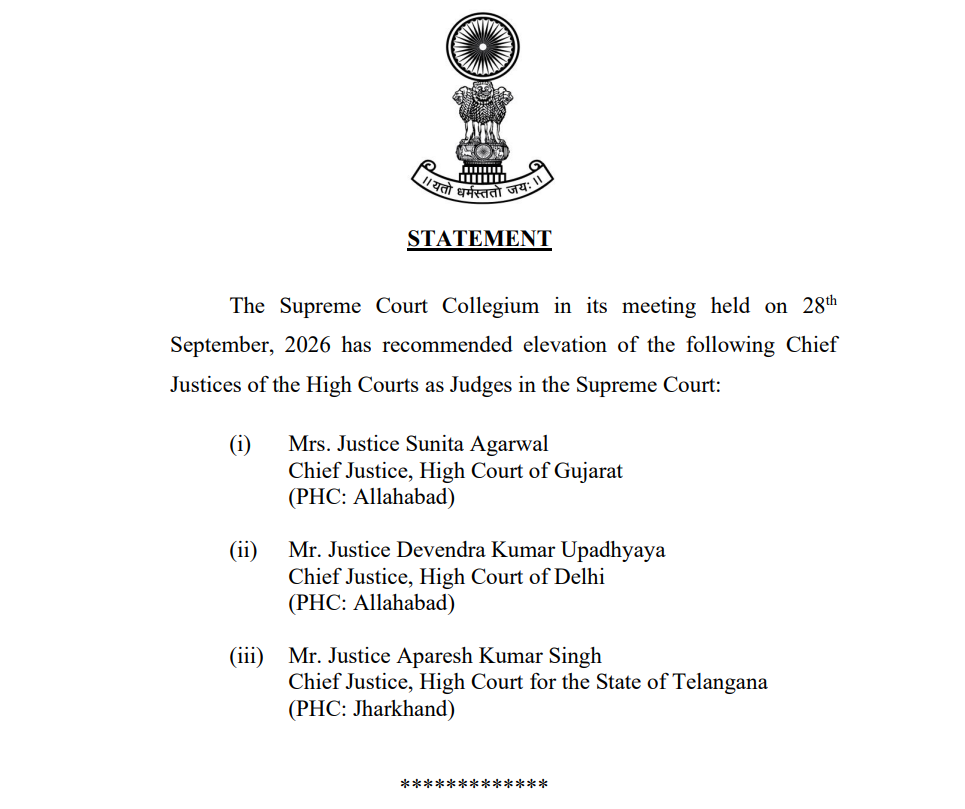
The Collegium, headed by Chief Justice of India Surya Kant, recommended on September 28 the elevation of Justice Sunita Agarwal, Chief Justice of the Gujarat High Court; Justice Devendra Kumar Upadhyaya, Chief Justice of the Delhi High Court; and Justice Aparesh Kumar Singh, Chief Justice of the Telangana High Court to the Supreme Court. The recommendations have been forwarded to the Union government for processing.
The recommendations are significant not only because they will shape the composition of the country’s highest court, but also because the higher judiciary has long faced criticism over the limited representation of historically marginalised communities.
The Union government itself has acknowledged that there is no reservation for SC, ST or OBC communities in appointments to the Supreme Court and High Courts, and that the Constitution does not provide for caste-wise reservation in these appointments. In a 2022 response, the Ministry of Law and Justice said that no central caste/category-wise data on judges is maintained. It also stated that, under the Collegium system, the responsibility for ensuring social diversity primarily rests with the judiciary.
A Judiciary Without Proportional Representation
Research on the composition of the higher judiciary has repeatedly documented the under-representation of marginalised caste groups.
A study published in the Asian Journal of Comparative Law found that between 1993 and 2021, only three Scheduled Caste judges had been appointed to the Supreme Court—K.G. Balakrishnan, B.R. Gavai and C.T. Ravikumar—accounting for about 2% of all Supreme Court judges appointed during that period. No Scheduled Tribe judge had been appointed to the Supreme Court during the period examined. The study also found that the Collegium has historically been a site of marginalisation for judges from disadvantaged caste communities.
This contrasts sharply with the demographic composition of India, where SCs, STs and OBCs constitute a substantial majority of the population. Yet the constitutional courts operate without a reservation framework or a mandatory proportional-representation mechanism.
Why Ambedkarites Have Opposed the Collegium
The Collegium system has also faced longstanding criticism from Dalit and Ambedkarite organisations and scholars.
The system, introduced through Supreme Court judgments in the 1990s, gives senior judges a central role in recommending appointments to the higher judiciary. Dalit and Adivasi activists have argued that an appointment mechanism dominated by judges themselves lacks sufficient democratic accountability and has failed to produce adequate representation of marginalised communities.
A 2023 report by Scroll documented opposition to the Collegium among Ambedkarite activists, who argued that the system had contributed to the extremely limited presence of SC, ST and OBC judges in the higher judiciary. The report also noted demands for an independent appointments mechanism with diverse representation.
The criticism is not confined to caste representation. The Collegium has repeatedly faced allegations of opacity, nepotism and the concentration of professional networks within the legal establishment.
Family Networks and Judicial Appointments
Family connections within the higher judiciary are a documented phenomenon, although available evidence does not establish that most judges are relatives of one another.
An analysis reported by Hindustan Times found that 32 of the 279 Supreme Court judges appointed between 1950 and May 2025 had close family relations within the judiciary or legal profession.
More recently, data published by the Supreme Court showed that 14 of 221 persons recommended for High Court appointments between November 2022 and May 2025 were related to sitting or retired judges. That amounts to about 6% of those recommendations.
These figures do not establish that judicial appointments are predominantly hereditary, but they demonstrate the existence of family networks in an institution where access to the legal profession and judicial office has historically been concentrated among socially privileged groups.
The Democratic Accountability Question
For Dalit and Ambedkarite critics, the central question is therefore not simply who becomes a judge, but who gets to decide who becomes a judge.
The present recommendations come at a time when the Collegium itself is being publicly debated. In September, Supreme Court Justice Dipankar Datta defended the Collegium against the description of it as a system of “judges appointing judges”, while also criticising what he described as selective clearance of Collegium recommendations by the Union government.
For its critics, however, judicial independence cannot be separated from social representation. A judiciary that exercises enormous constitutional power over reservation, affirmative action, caste discrimination and fundamental rights is also being questioned for the limited representation of the communities most affected by those questions.
The latest recommendations therefore raise a broader institutional issue: if the higher judiciary remains overwhelmingly drawn from socially privileged backgrounds and there is no statutory mechanism for proportional representation, how democratic and socially representative can the country’s most powerful unelected institution become?